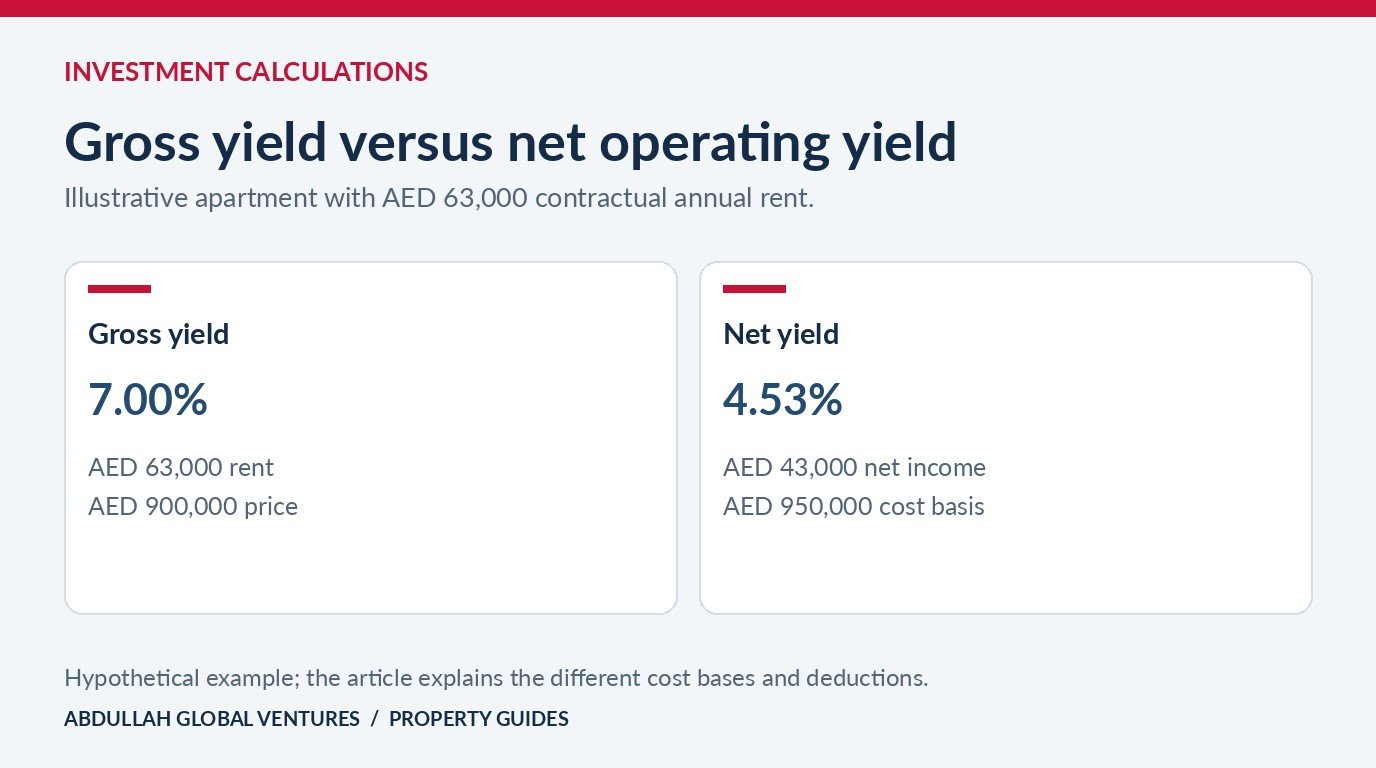
Gross yield is the annual rent divided by the purchase price, expressed as a percentage. Net rental yield subtracts relevant property operating expenses from the annual income before dividing by a defined property cost. There is no value in comparing two yields without checking their inputs: some calculations use the sale price, while others use the acquisition cost including fees.
A worked comparison in dirhams
Assume a completed apartment costs AED 900,000, earns contractual annual rent of AED 63,000 and requires AED 50,000 of acquisition costs. The gross yield is 63,000 divided by 900,000, or 7%. The initial investment basis including fees is AED 950,000. Gross income relative to that basis is approximately 6.63%.
Now assume expected vacancy reduces annual receipts by AED 5,250, building charges cost AED 9,000, management costs AED 3,000 and routine repairs cost AED 2,750. The resulting operating income is AED 43,000. Dividing by AED 950,000 gives a net operating yield of approximately 4.53%. These are hypothetical assumptions, not market averages or a promised outcome.
Reproduce the figures
| Input | Amount |
|---|---|
| Purchase plus acquisition fees | AED 950,000 |
| Annual contractual rent | AED 63,000 |
| Vacancy allowance | − AED 5,250 |
| Service charges | − AED 9,000 |
| Management | − AED 3,000 |
| Routine repairs | − AED 2,750 |
| Net operating income | AED 43,000 |
| Net operating yield | 4.53% |
Which costs belong in the numerator?
Include recurring operating expenses paid by the owner: service charges, relevant insurance, management, expected maintenance and vacancy losses. Avoid counting vacancy twice by using both a reduced rent figure and a second vacancy deduction. Major capital work may need its own reserve or a separate annualised assumption. Disclose what has been included so someone else can reproduce the calculation.
Financing belongs in a different measure
A mortgage changes the owner's cash receipts and equity contribution. Principal repayment builds equity but still consumes cash. Interest is a financing cost. To examine money remaining after debt payments, use a separate cash-flow model and compare it with the capital the owner actually committed. The buy-to-let cash-flow guide covers that distinction.
Compare on equal terms
Use registered lease evidence and the approved building budget to replace the assumptions in the worked table. Keep the acquisition basis and operating costs consistent across properties.
Official references: DLD service charge index · DLD real estate data
Calculate both properties on the same basis and for the same period. If a developer quotes gross yield on a future rent while a resale seller supplies actual net income, normalise both before drawing conclusions. Net yield also does not include a future change in the sale price or the cost of exiting the investment. The purpose of this calculation is transparency: you should know which costs explain the gap between advertised rent and the income retained.